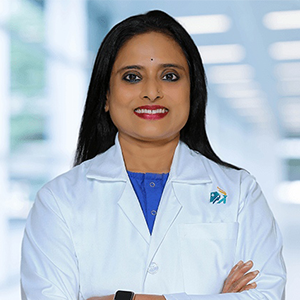
Dr. Jayanti Thumsi is an esteemed breast cancer surgeon, holding the role of Group Lead – Robotic & Advanced Breast Surgery at HCG Hospital, Bengaluru. Her impressive career spans over 8,900 surgeries.
India's Pioneer in Robotic Breast Surgery
She is the first surgeon in India to have performed the most advanced procedure — Robotic Breast Surgery with reconstruction — transforming outcomes and confidence for patients.
Awareness & Education
Dr. Jayanti actively conducts extensive awareness programs, educating more than 6.2 lakh women across India and many other countries. Under her leadership, a unique event was organised — 'World's Largest Campaign for Breast Self Examination' — wherein in a single day, 2,332 women were individually taught breast self-examination. This landmark event was recognised by the Limca Book of Records.
Author — Lump to Laughter
Her dedication to education is evident in her authored work, "Lump to Laughter", now in its third edition. This book sensitively details the emotional journey of her patients while incorporating crucial medical facts — a compassionate guide for patients and families navigating breast cancer.
Collaboration with Enable India
She has collaborated with Enable India to train visually impaired women in innovative tactile techniques for breast cancer detection — breaking barriers and bringing early detection awareness to every woman, regardless of ability.
Awards & Recognition
Her exemplary contribution has been recognised at various National and State platforms.
2025
"My vision is to build a future where breast cancer is detected early, treated effectively, and survivors find strength in the support of a united community — where the patient is healed physically and emotionally."— Dr. Jayanti Thumsi
Areas of Expertise
Straight answers from Dr. Thumsi on the questions patients ask most.
Since childhood it was my dream to become a doctor — I am the first doctor in my family of engineers. Breast cancer chose me just as much as I chose it. Early in my career I saw how deeply this diagnosis affected not just the body, but the mind and identity of a person. That emotional and human aspect made me commit to this field.
I don't think of it as popularity — it comes down to trust. I make it a point to spend time with every patient, answer every question honestly, and involve them in decisions. When people feel respected and supported, that connection naturally spreads through word of mouth.
Specialisation matters most — breast surgery is not general surgery. Look for someone updated on recent advances, who communicates clearly and works with a multidisciplinary team. Access to advanced techniques like oncoplastic or robotic nipple-sparing mastectomy can make a significant difference in outcomes. Most importantly, patients should feel comfortable and heard.
The most common sign is a lump — but it's not the only one. Changes in breast shape, skin dimpling, nipple discharge, or even subtle changes like thickening of the skin can all be warning signs. My key message: don't ignore anything unusual. It's always better to get something checked early than wait.
While we can't control everything, we can certainly reduce risk. Maintaining a healthy lifestyle — regular exercise, balanced diet, limiting alcohol — plays a role. Breastfeeding also offers protection. But most importantly, regular screening and awareness are critical. Early detection can make all the difference.
Fear often comes from the unknown. The first step is to replace uncertainty with clarity. I make sure patients understand exactly what's happening, what the plan is, and what to expect. I also remind them they're not alone — there's a whole team supporting them. Sometimes, just sitting down and having an honest conversation can ease a lot of anxiety.
Preparation is about mindset as much as the body. Physically, following medical advice, staying active, and eating well helps recovery. Mentally, I encourage patients to ask questions, understand the procedure, and focus on the goal — healing. Talking to survivors can be incredibly empowering. It's okay to feel scared — but don't let that fear take control.
Genetic testing is very important — but only for those who have a strong family history or specific risk factors. It's not something everyone needs. These tests are available in India at an affordable cost. Preventive surgery is a deeply personal decision and should only be taken after careful counselling. The key is personalised care — what's right for one person may not be right for another.
Don't delay. Breast cancer is curable if we detect it early and receive appropriate and timely treatment. Cancer need not be a word to be scared off. Regular monthly self-examination from age 20 and yearly screening mammogram for women above 40 is what I recommend. Awareness and early detection save lives — and that is the way forward.
Dr. Thumsi busts the most harmful myths she encounters in her clinic — every day.
Breast cancer only affects older women.
In India, more than 48% of women who develop breast cancer are under 50 years of age. It can strike a woman as young as in her 20s or 30s.
Every lump means cancer.
80% of lumps are non-cancerous. That said, any new lump should be evaluated by a specialist promptly — don't panic, but don't ignore it either.
No family history means I'm completely safe.
90% of women who develop breast cancer have no family history. Regular screening remains essential for everyone.
Treatment means losing your breast and femininity.
Today's advancements — including reconstruction and nipple-sparing surgery — allow us to preserve both form and confidence in many cases. Treatment does not mean loss of identity.
Surgery spreads cancer.
This is simply incorrect. Surgery is one of the most effective and definitive treatments we have for breast cancer.
Reach out to book a consultation or learn more about treatment options.
Location
HCG Cancer Centre
Bengaluru, Karnataka, India
OPD Hours
Monday – Saturday
9:00 AM – 5:00 PM
Appointments
Call HCG helpline
1800-108-1301 (Toll-free)
Online
Book via HCG website
or your preferred health app
Screening Reminder
Monthly self-examination from age 20 & yearly mammogram from age 40 — recommended by Dr. Thumsi for every woman.